

After listening to the earnings for ABAT 0.00%↑ and going over the 10-K, only a few things I think need to be covered.
First, on the earnings call, Ryan brought up that they were debt-free twice; he only repeats something if he really wants to drive home a point. If you know anything about the senior secured notes and a lawsuit that was using that debt as grounds that the company was a grifter, you would know that for Ryan it is a major accomplishment to wipe that debt off the books.
But I think it is more than that, and I have a feeling we are going to see them release the framework for some debt that they are negotiating that is free of any baggage from the last few years and that is also not OTC levels of toxic. Debt is not bad, and for a company like ABAT, well-structured long-term debt non dilutive or at least if it is deferred dilution would be embraced by investors.
On the black mass export rule, as I figured since this is fairly new, it was a rush to submit, and now the Department of Commerce has to figure it all out; remember, they are using the DoD framework for a export restriction. But overall I am not really worried about it, but it does bring up something that I talked about in the chat during the call.
It was clear that the company was taking things slow, and to be honest, I think the Ascend Elements bankruptcy scared the bejesus out of the sector. Li-Cycle was kind of a given, but Ascend was a different story, and even with the brilliant legal moves by Ascend’s counsel, the company was still liquidated.

So I have a feeling ABAT was content to let the recycling vertical grow organically, use its profits to help expand and build out the platform, and let Tonopah work itself out. Grow but don’t overreach or over extend itself.
The BIS rule has changed that, and they are now at a crossroads: pivot away from recycling or at least downgrade its importance in the company, or make a push forward and get moving on battery grade. I think that ties into the debt that we may be seeing them take on.

Outside of that, the overall financials are for a speculative startup that is also a junior; unique but also nominal I think is the best phrasing to use here. Having a positive gross margin on black mass production is a great start, but do not expect that to stick around once they start into battery grade, well at least for a while. Once they start moving again, they are going to wreck that gross margin.
But that does bring up something that was kind of buried in the 10-K:
“an increase in legal expenses of $0.5 million related to site selection,”
Now then, I am sure they had legal expenses for the Ascend Elements bankruptcy; they were just trying to use a clear path argument to be declared the winner of the auction for the Kentucky property. But they also most likely had legal expenses for the lot next to the TRIC facility. But not $500,000 worth of legal expenses. Could they be close to picking a site for the second facility? That seems logical to me.
As for it being the Kentucky property from the Ascend bankruptcy? If it is, it better be Dollar Store prices and they are able to leverage a good portion of the DOE grant for it right off the bat.
The property and equipment table in the 10-K: before I was always saying cash COGS was where we needed to look at to see how the company was doing; now they have progressed far enough that table will be a good metric to see where they are at.
The big thing here is the construction in progress jumped almost $4 million while equipment dropped by $1.3 million. Speculation is they are working on getting new assets up and running, but also have not added enough new equipment, and depreciation is now eating into the value of that equipment.
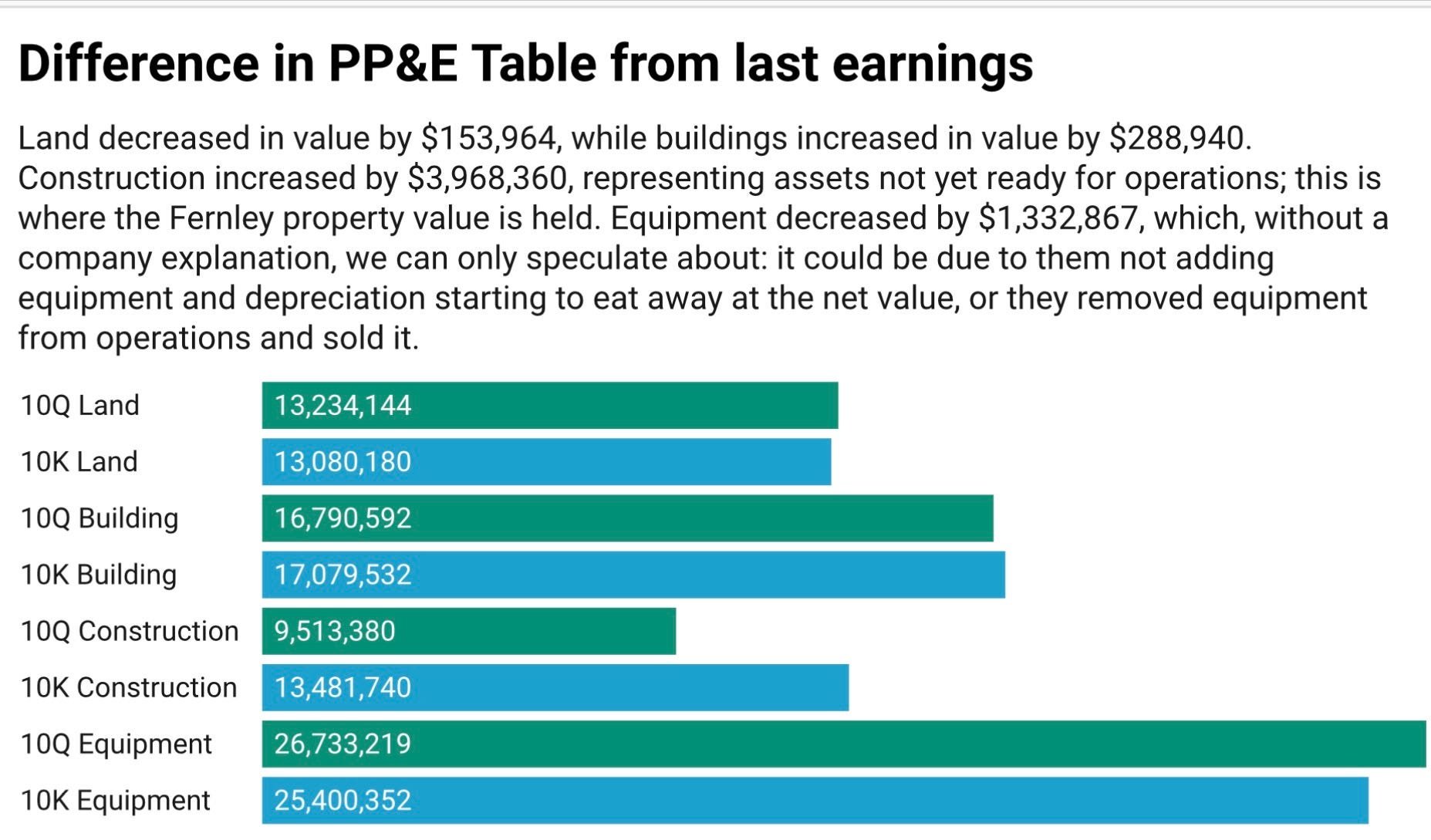
This just supports the theory that they were content to let the recycling vertical continue operating while just adding upgrades for efficiency with no real push to expand it.
Beyond that, if you listened to the last earnings call, there really was not much new: some pomp and circumstance with the DOE visiting the TRIC facility, and he did actually go into some detail about NEPA, which was nice since the PR that they released talking about the final step needed to start the NEPA review, the BLM accepting the Mine Plan of Operations, didn’t include it all.
As for any recent FOIA requests, I think Tiffiany has gotten better at making sure that confidentiality agreements are in place, so there have been no new documents on that front.
The shareholders meeting is in November, so I guess we will talk about American Battery Technology Company again in November. As always, however, if you have a question send it my way. I may not be able to answer it or give you an answer that you want, but I will do my best to answer it factually.
If you found this article valuable, consider becoming a subscriber. The Critical Materials Bulletin is supported by readers, and for $5 a month or $55 a year you can help fund research that produces clear, no nonsense reporting that informs and advances the discussion on critical materials and battery metals.
Alternatively, if do not want to commit to a subscription, you can instead buy Abe a treat or two. And in doing so you can help support my goal of taking the Critical Materials Bulletin on the road, to visit these facilities as they launch, and to continue my conversations with these companies in person.
Buy

DISCLAIMER: This article should not be construed as an offering of investment advice, nor should any statements (by the author or by other persons and/or entities that the author has included) in this article be taken as investment advice or recommendations of any investment strategy. The information in this article is for educational purposes only. The author did not receive compensation, from any of the companies and or persons mentioned to be included in the article.