A Reply to a ST Poster and an Update on Ascend Elements’ Bankruptcy.
A quick response to why I cover more than one lithium-ion recycling company, and a overview on what the 363 sale proceedings mean for Ascend.
First, in response to this guy over on Stocktwits.
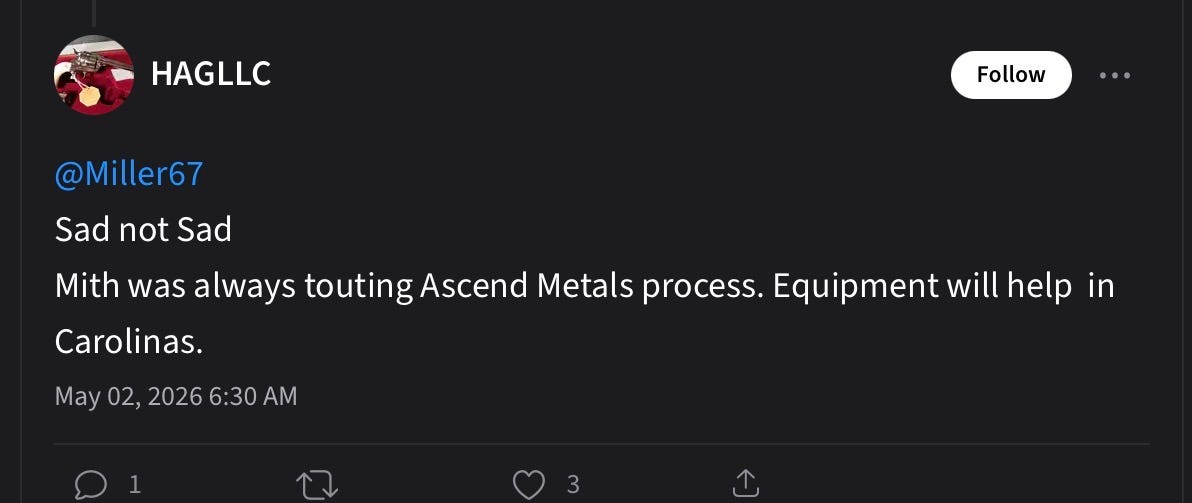
I have, as some would say, gone over Redwood Materials’ process in ad nauseam, and I have also broken down at least a dozen other processes. People want to understand the industry, and I have always said that if you have a basic grasp of the technology, everything else falls into place.
If you were looking for a comparison, Ascend and ABTC are a logical pair. Ascend will produce a collective intermediate product and then convert it into an engineered product in-house, while ABTC will produce individual salts that can either be sold directly or, in the case of a tolling contract, a business model Ascend also uses, be returned to the feedstock owner. Those salts can also be further processed into an engineered product by ABTC’s partner BASF, depending on the client’s needs.
Where they are similar is that they both produce a lithium-depleted black mass, but how they get there is different. Ascend has a patented pending carbonation method for producing lithium carbonate that is built into the black mass production component. ABTC has a trade secret protected hydrolysis component that produces a lithium intermediate, which is fed directly into an electrochemical lithium hydroxide conversion platform.
That difference in approach reflects the roles they will fill within the supply chain. One will be focused on removing impurities and producing precursors. The other will be focused on extracting and refining specific salts to give OEMs more control over their inputs. By knowing those differences, you can better understand how they will solve different problems in the supply chain.
As for an idea that is common among retail investors, competition. Competition is a good thing, and in the lithium-ion industry it is essential to driving innovation. While Ascend and ABTC will be competitors, they will also be working together in the broader effort to build out a domestic battery metals infrastructure, and both will be vital to solving a problem that I go into in more detail below.
It is through an understanding of the technology these companies will be deploying that you can see how and where they will fit into the industry as a whole.
Ascend Elements Bankruptcy Update
One of the core confusions is that people see a bankruptcy filing with sale dates on the calendar and assume the company is being dismantled. The reality is the opposite. The dates exist because the court requires a structured process before any sale can happen. The schedule is procedure, not a liquidation countdown.
Ascend filed Chapter 11 specifically to preserve the assets as a whole and find a buyer who can fund continued operations. Linh Austin, the current CEO, stated in the First Day Declaration that the cases were commenced to stabilize operations, preserve liquidity, and provide the breathing room necessary to explore an asset transaction that would provide the best value to the company and its creditors. A sale was already being negotiated before the filing, as confirmed in the filing itself, but the weight of the outstanding debts made it impossible to close.
The 363 sale package people are now posting about gives them a court-supervised framework to do that cleanly, and the protections that come with it make a completed transaction more likely now than it was outside of bankruptcy. The filing itself confirms over $145 million in statutory liens from contractors and subcontractors actively clouding the assets, with related litigation still pending in Kentucky state court. Without the bankruptcy process those liens make the assets nearly unsaleable.
The simple version: they filed bankruptcy to preserve the assets, not to sell them off for scrap. The calendar dates are the court’s way of ensuring the process is orderly, transparent, and competitive. While some creditor filings argue the timeline is compressed and the sale process is being rushed, it is still just a procedural schedule set by the court.
Where the media got the narrative wrong.
It is also worth spending some time on how Ascend got to this point. The DOE grant cancellation makes for a convenient headline, but the more honest read is that the inexperience, and perhaps the hubris, of the previous management put this company in a hole before the current team, the one that filed for bankruptcy, ever walked in the door.
That may sound like the company looking for a convenient scapegoat, but in this case the public information largely points to that conclusion, and Austin himself confirmed it in the First Day Declaration, stating that the reconstituted management team inherited a set of pre-existing operational and financial challenges including near-term liquidity pressures, construction delays, and cost disputes with contractors.
Ascend was originally awarded two DOE grants totaling $480 million: a $164 million CAM grant and a $316 million pCAM grant. The CAM grant was voluntarily returned in February 2025, just weeks before Austin formally became CEO, citing changing market conditions. I wrote this in an article after the news about the CAM grant was released.
Ascend Elements’ decision to drop CAM production and its associated grant to only produce pCAM, backed by a $316 million grant, fits a U.S. market where cell manufacturers like StarPlus Energy, LG Energy Solution, and SK On stick to entrenched CAM processes, leaving little room for new CAM suppliers. pCAM, derived from black mass and tailored to an OEM’s specific requirements for their CAM process, adds value and allows more OEMs to produce CAM using domestically sourced recycled material as well as primary sources.
In reality it was not changing market conditions but rather a complete misread of it by the former management.
Austin had been on the board since September 2024 and per the First Day Declaration was asked to step into a more direct advisor role in December 2024, so if I had to guess he was the one who pushed that grant return before the title change was even official.
Then in October 2025 the DOE canceled the remaining $100 million of the pCAM grant. A DOE spokesperson Ben Dietderich said in a statement:
The projects had missed milestones, and it was determined they did not adequately advance the nation’s energy needs, were not economically viable, and would not provide a positive return on investment of taxpayer dollars.
If you look at the delays at Apex 1 and the delays on other projects that had their grants terminated, that is a logical assumption to make, the milestone part at least, the rest could be debated.
As for the company’s response, Austin said at the time that the DOE decision did not change their trajectory and that they would replace the funding with equity, project finance, and municipal bonds. What that statement did not reflect was that the liquidity crisis was already well underway, construction had been halted, contractor liens were piling up, and the company was already in discussions with noteholders about bridge financing.
The grant cancellation did not cause any of that. It just removed one more possible solution from a list that was already getting shorter. By the time eight of the eleven senior leaders had been replaced, the structural damage was already done and, for all practical purposes, the course the company was on was irreversible.
The September 2024 timeline tells its own story. On September 9, 2024, SK ecoplant, Ascend’s largest individual equity holder with a board seat, sold its entire 7.7% stake to Seoul-based SKS Private Equity for approximately $98 million. That same month the COO and VP of Construction both quietly left the company, and Austin joined the board. Less than two months later the work suspension directive at Apex 1 was issued. A major strategic investor with inside knowledge of the company did not stick around to see how it played out.
Much of what happened can be laid directly at the feet of former CEO Michael O’Kronley. For those of us who had been following this company from early on, who admired what Ascend was trying to do and the caliber of the people attached to it, the incompetence at the top was never far from the conversation.
I still need to dig up the post, I do mention some of it in the Redwood article I linked to above, where I went off about O’Kronley routinely in interviews and panels botching basic concepts like tolling contracts versus market orders, and confusing closed-loop and linear economy concepts with scrap and end-of-life feedstock supply.
There is another aspect of his leadership worth looking at. I said before that I was not sure who was better at getting funding from investors, Ascend or Redwood. Both were raking in capital. Ascend alone raised over a billion dollars across its Series C, Series D, and subsequent rounds between 2022 and 2024.
The First Day Declaration confirms that in 2023 and 2024 alone roughly $650 million of that went toward the buildout of the Apex 0 and Apex 1 facilities, that was equity, not debt. The Senior Secured Convertible Notes and Junior Secured Convertible Notes came later in 2025 as bridge financing, by which point things were already deteriorating. The capital was there. The problem was not the ability to raise it, it was the ability to deploy it effectively and keep the projects on track.
Their communications strategy was not much better. While they were excellent, and in my opinion the best in the industry, at providing educational material about lithium-ion, their ability to communicate with the general public about the company itself was abysmal. This is a common problem for the companies in the industry, and one I have pounded the table about non-stop and have been very vocal about.
I had a LinkedIn exchange with an executive who was, at the time, their SVP of Communications, and I was informed that they built their messaging around what journalists ask for. That is, in my view, one of the most asinine approaches to developing a communication platform and engaging the public. The only worse approach is locking everything behind the phrase “proprietary technology.”
I believe I told him to get an intern to look at social media. Not to engage directly, never do that, but simply to observe. You would see very quickly that the information journalists are pushing is often full of irrelevant noise that ends up driving more misinformation, not less.
And Ascend is now seeing the result of that communication platform, with headlines stating that it was the grant cancellation that was the core reason they had to file for bankruptcy.
What the 363 Sale Actually Means
According to a declaration filed by Jefferies Managing Director Michael O’Hara, who is leading the sale process on Jefferies’ side, Jefferies contacted approximately 120 potentially interested parties and executed around 18 confidentiality agreements during the process, which kicked off in fall 2025 and was re-engaged in March 2026 when liquidity issues reached a breaking point.
This tells you they were trying to find a buyer well before they ever walked into court. They were also looking for a DIP lender at the same time, which is basically someone willing to loan the company money to keep operating during the bankruptcy process itself. Those are two separate asks, and at the time of filing they had neither.
Separately, a creditor objection filed on May 1 by United Electric Company, Inc., which is owed at least $18.7 million and is part of a broader group with more than $120 million in mechanic’s and materialman’s lien claims, argues that the sale process is being run on a compressed timeline that benefits the secured noteholders.
The filing points out that these noteholders are not putting in new capital, while still seeking significant control over the case and the outcome, including having a hand in a process that will ultimately determine how their own debt gets resolved.
The key dates are as follows per public information.
The IOI deadline was May 1 and has now passed. An IOI, or indication of interest, is the first step where potential buyers signal they want to learn more before committing to a full bid. An April 30 filing sought approval to keep certain parties confidential, coming one day before the IOI deadline, which could logically include parties that submitted IOIs or were considering doing so.
The stalking horse designation deadline is May 6. The bid deadline is May 9. The baseline bid deadline is May 11. If more than one qualified bid is received, the auction is scheduled for May 12 at 10:00 a.m. CT at Norton Rose Fulbright’s Dallas office.
No stalking horse has been named yet. A stalking horse is essentially the baseline buyer, the party that sets the floor price for the auction and receives certain protections, such as a break-up fee if another bidder prevails. Having one in place signals to the market that there is meaningful interest and provides a credible starting point for the process.
The absence of a named stalking horse suggests Jefferies is still working the process, although it is also possible that one exists but the identity is being withheld for now and may not be disclosed even if a stalking horse is announced, potentially until later in the case or after key legal milestones are completed.
The second day hearing is May 7, which is where the motions that were only granted on an interim basis at filing, things like cash management and critical vendor payments, get finalized after creditors have had a chance to object. It is also where the court gets a look at where the sale process stands given the timeline. This upcoming week is going to tell us a lot about where this ends up and possibly the final outcome for Ascend Elements.
Closing Thoughts
The loss of Ascend Elements as a lithium-ion recycler could have serious consequences for the United States’ effort to build a domestic battery metals supply chain. This is similar in effect to the loss of Li-Cycle, a company that failed due to major missteps by management; in their case it was overreaching instead of focusing on what was needed now, not what would be needed in five years.
With the loss of Ascend, the existing infrastructure is nowhere near large enough to absorb their roughly 30,000 tons per year of scrap and end-of-life processing without disruption, and that jeopardizes the buildout of a domestic supply chain.
Just the other day, I covered a startup focused specifically on lithium-ion black mass production, which also appears to have the corporate logistics infrastructure needed to export that material out of the United States into Asia. Without Ascend, it becomes more likely that what are effectively national security and economic resources will be lost to China.
In a previous article, I was able to submit questions via a third party to Ascend Elements, and they had one of the best answers when it came to the problem of losing feedstock to China:
Ascend Elements: Our model is designed to facilitate use of materials in-region via secure logistics, documented chain-of-custody, and fee-for-service/tolling options that return cathode precursors or lithium salts directly to U.S. customers. With Georgia online and Kentucky staged, and with Poland ready to serve EU demand, we expect meaningful U.S. processing headroom to expand over the next five years, especially as we replicate our already-commissioned Georgia line in Kentucky. That scaling, combined with customer tolling, is the best answer to keeping black-mass refinement in-region.
It is going to take quite a bit more than one or two domestic lithium-ion recyclers to build the infrastructure needed, especially given the long lead times associated with primary mining and refining projects. Each recycler plays a role in lowering input costs and improving the competitiveness of cells produced in the United States.
Without them, cell manufacturers will continue to be dependent on imported inputs, which raises costs and will limit their eligibility as vendors for federal infrastructure programs.
I have had no direct communications with the company since the change in management, and while I had plans to reach out to them after the bankruptcy announcement, I decided not to due to what are most likely confidentiality issues surrounding the legal case and the limitations on what they would be able to share.
While I do not have any insider information pertaining to the legal case or the operating status of the company right now, I was contacted by someone that is knowledgable of the company and while nothing of substance or any specifics about the case was shared, the overall tone in the email was very optimistic.
And that is the thing: the industry needs good news and could stand a small injection of optimism; it has been a rather dour few years for the lithium-ion recycling sector. Not only is it getting rather tiring to constantly be covering negativity in the space, but investment has to start flowing again if any of the operations needed to move the industry forward are going to materialize, and that is unlikely to happen against the backdrop of the current bleak sentiment investors are facing.
What the sector needs right now is a clear signal that progress is still possible, and a leaner, more efficient Ascend Elements emerging from bankruptcy is exactly that kind of signal.
If you found this article valuable, consider becoming a subscriber. The Critical Materials Bulletin is supported by readers, and for $5 a month or $55 a year you can help fund research that produces clear, no nonsense reporting that informs and advances the discussion on critical materials and battery metals.
DISCLAIMER: This article should not be construed as an offering of investment advice, nor should any statements (by the author or by other persons and/or entities that the author has included) in this article be taken as investment advice or recommendations of any investment strategy. The information in this article is for educational purposes only. The author did not receive compensation from any of the companies mentioned to be included in the article.


