The Problems with Comparing Speculative Lithium Extraction Platforms to Legacy Systems
A lot to unpack here.
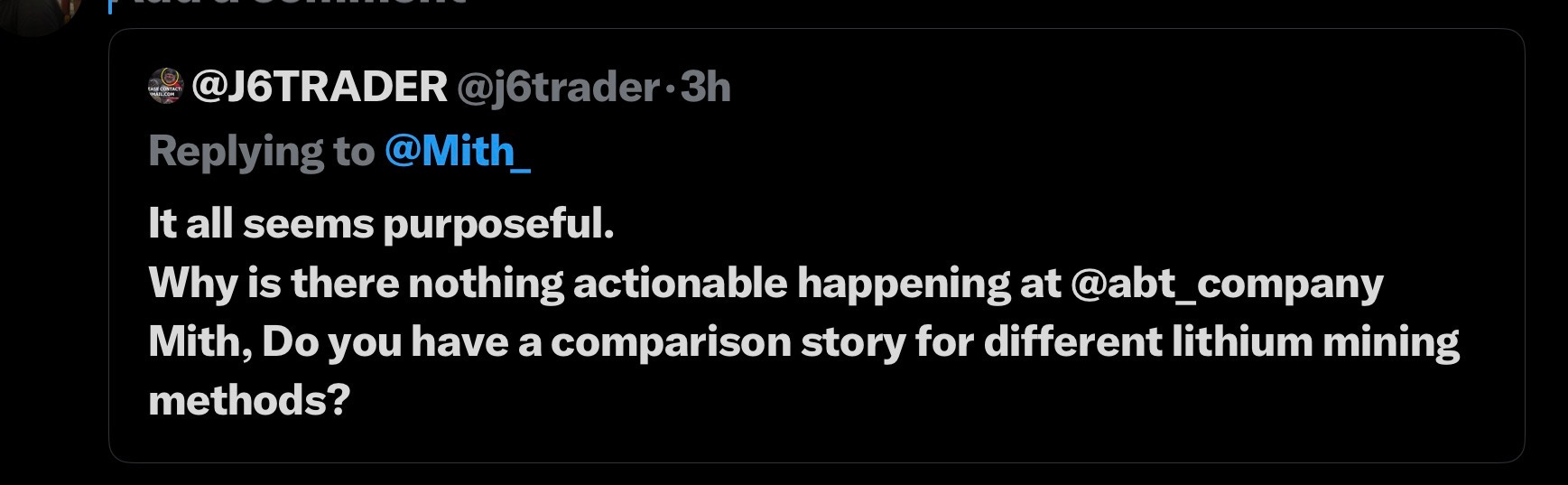
Luckily the first part is easy. If I had to guess, ABAT 0.00%↑ has around 10 specific aspects of their technology that are covered under trade secrets. I was reminded how competitive the industry is when a friend shared an article that BASF and Duracell are back at it, with BASF suing them for infringement of their trade secrets.
Trade secret laws allow ABAT a lot of wiggle room in what they are required to divulge to the public under SEC rules, and I think at times they are going way too far in claiming proprietary technology as a reason they are declining to answer basic business model questions. But I have to acquiesce to the idea that the safest policy is to treat everything as a potential hazard to the protections they are afforded under trade secret laws.
So it is not that nothing actionable is happening at the company, and I do not for a second at all think that, rather they are not willing to publicly announce anything that may have an adverse effect on their protections.
As for the mining methods, my OG X post was referring to this:
To produce this lithium hydroxide, ABAT developed its own proprietary extraction technology that uses selective leaching and purification rather than the environmentally intensive evaporation ponds or high-temperature roasting used by conventional producers.
That there is some of the slop that Maxim Group dropped in its pump piece, which I have to agree with the consensus is a prelude to an offering. I am not against the company doing an offering, but as an investor I want to know the specifics of what they plan to use the funds for, not the standard boilerplate that it will be used for expansion and general operating expenses.
But the wording in the report is a common phrasing when the analyst knows less than even the average retail investor. Not every region is going to have the same resources. For example, the spodumene that the Secretary of the Interior is promoting, using restaurant math and sleight of hand, is what is available in regions like the Carolina tin-spodumene belt, not claystone. Interesting fact, however, the claystone flowsheet up to extraction is based on spodumene mining.
I am working on a piece about the new USGS release on Appalachian lithium and will have that out this week. But I have looked at the Carolina tin-spodumene belt in an earlier piece.
And where the environmental aspect that is different comes into play is how the lithium is extracted, but the Maxim Group are doing the same thing so many juniors are doing, using legacy technologies to prop up the platform they are promoting. Spodumene has to be calcinated at high temps then leached using an acid roast circuit. All of that was historically done using carbon intensive energy infrastructure that was compounded by the fact that the spodumene had to be shipped from Australia to China.
That is all changing, gases from the process are being collected, cleaned, or even like in the case of Tesla used to create the reagents they need for the extraction and conversion.
Side Note: Speaking of Tesla, the usual suspects were harvesting views again by cherry-picking two minerals that showed up in water tests in a ditch, causing people to clutch their pearls at the alleged evils Tesla is perpetrating, while ignoring that the water was in a drainage ditch and that the discharge from the pipe at the Tesla lithium refinery was not what was tested.
Of course, the real story was not really about the minerals they highlighted, because they didn’t do the research. Rather, it was the high salinity in the ditch water that very well could be caused by waste from the Tesla facility, based on the alkaline leach process they are using instead of a standard acid roast.
The energy sources that these sites did use are now moving to renewables. To put it this way, what Maxim wrote is only relevant if we refuse to look at the last 10 years of innovation when it comes to lithium extraction.
The addition of evaporation ponds just further reinforces that the analyst that wrote this was going off a script and copy and pasting. If you want to compare it to a brine you would use direct lithium extraction, and the most common of that type is absorbent, where you pass the brine through what is basically a sponge with lithium shaped holes that mostly traps just the lithium.
The bulk of the lithium projects in the US will be brines, the main drawback is while a single claystone project will be able to have a initial production of 30,000tpa of LCE a brine project would max out in the range of 5,000tpa to 25,000tpa of LCE. But then you start to get into the oilfield brines where you have tens of thousands of sites that can be set up to extract and convert around 10-100tpa of LCE from oil and gas production waste.
And while metal extraction from clay is not truly new, look up aluminum, the lithium extraction process shares a lot of the same fundamental aspects as the Bayer process: selective dissolution from a clay followed by extraction and purification, this is the same engineering framework. To get a real 1:1 however you have to compare extraction of lithium from claystone to other claystone projects, the problem is you would be comparing demonstration scale to demonstration scale and not commercial, which can only look at the differences and possible advantages one has over the other. Of course that has never stopped me from at least exploring the technology.
Each region is going to have its own lithium resource, and all of them have next-generation technologies being leveraged to extract that lithium. In order for the lithium-ion industry to succeed in the US, it is going to require as much lithium as possible from all these different types of sources, and even then that may not be enough.
Including legacy comparisons or distorting the extremely fast paced and innovative path the industry is on, one that already takes a good portion of my day just to keep up with, in order to prop up one platform is sophomoric and asinine.
If you found this article valuable, consider becoming a subscriber. The Critical Materials Bulletin is supported by readers, and for $5 a month or $55 a year you can help fund research that produces clear, no nonsense reporting that informs and advances the discussion on critical materials and battery metals.
DISCLAIMER: This article should not be construed as an offering of investment advice, nor should any statements (by the author or by other persons and/or entities that the author has included) in this article be taken as investment advice or recommendations of any investment strategy. The information in this article is for educational purposes only. The author did not receive compensation from any of the companies mentioned to be included in the article.


