

The audio of the Ascend Elements bankruptcy hearing that was held today was released and I listened to it, and the TL;DR is the bankruptcy is over, with one minor detail that really does not involve Ascend Elements anymore.
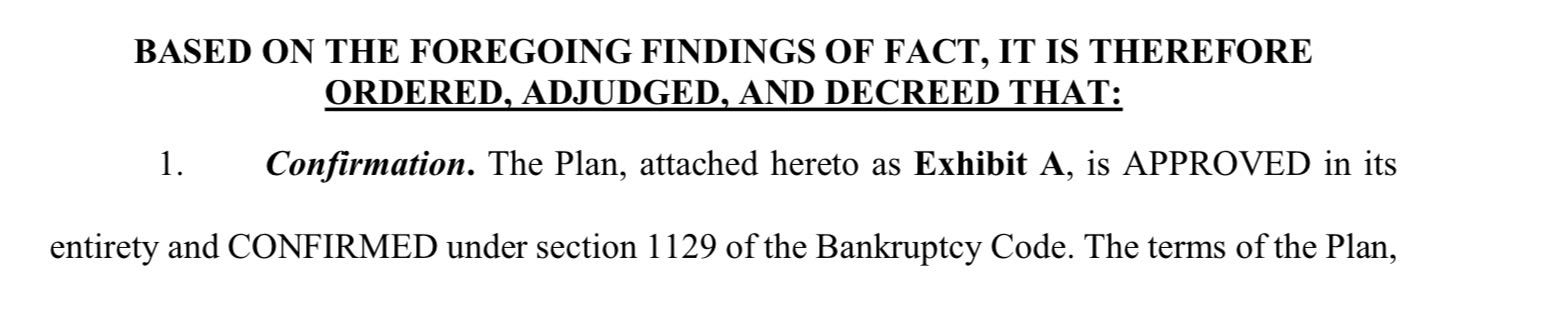
The judge approved the final plan, which is the plan to close out and liquidate Ascend Elements. What started out as a Chapter 11 case to reorganize and save the company ended up shifting into a full liquidation after its major operating assets were sold off.
In plain terms, a Chapter 11 usually tries to keep a business alive, but when that fails, the company sells off everything it owns piece by piece and distributes the cash to pay off creditors before shutting down entirely.
This has been an action-packed 4 months and this case has taken on a number of twists and turns. You never know which case is going to present more complicated issues and this case had many moving pieces and very complicated issues. Very large disagreements between certain stakeholders proposed sales of assets that were heavily contested and changes to those sales and ultimately the approval of certain asset sales after changes to procedures in order to ensure due process to all parties. ~ Christopher M. Lopez United States Bankruptcy Judge.
Asset Sales:
Poland and Intellectual Property: Sold to Bluegrass Infrastructure Partners for $3.0 million in cash plus a $98.0 million credit bid, closing on May 26, 2026.
Hopkinsville Facility (Apex 1): Sold to Turner-Kokosing Joint Venture (TKJV), closing on June 10, 2026, with a total claim reduction of $50.0 million (including a $40.0 million waiver at closing).
Covington Facility (Apex 0): Sold to R3 Lithium for $3.0 million in cash, approved on June 30, 2026.
Debt Outcomes:
Secured Notes Extinguishment: The $20.0 million senior secured notes and $83.1 million junior secured notes were fully satisfied through credit bids and asset sales, leaving zero remaining funded debt from the noteholders.
General Unsecured Claims (Class 3): Totaled at approximately $149.6 million, with projected recoveries estimated between 0.0% and 0.4% through a GUC Trust holding residual assets and retained litigation causes of action.
Settlements:
Department of Energy Settlement: Resolves $15.9 million in potential reimbursement liability for $7.5 million, satisfied entirely via setoff against remaining grant closeout funds rather than an out of pocket cash payment.
AMCON Lien Dispute: Resolved via a stipulation approved on August 10, 2026, granting a $1.175 million secured claim paid from the Covington proceeds escrow and waiving an 8.7 million dollar unsecured claim.
There were two objections to the final plan.
One was by the U.S. Trustee, a federal official overseeing bankruptcy cases, who argued that the special committee’s actions overlapped those of the trustee’s. The judge dismissed the objection, ruling that the committee’s actions were appropriate and justified in this case.
The second one was by the Georgia Environmental Protection Division and they had an objection due to the fact they want to rollback the sale order of the Covington facility to R3 Lithium, due to them failing to include a financial provision in it. Several times the Judge stated he was confused on why this was an issue being brought before him, and he was not the only one.
Nowhere in the final plan being ruled on today was there anything to do with the sale order of the Georgia facility to R3 Lithium besides being included as background information. In fact, the judge asked where the Georgia lawyer was getting the deadlines they were listing, and she responded it was in the sale order. The judge had to explain that he was there to make a ruling on the final plan and that if the Georgia EPD wanted to contest the sale order, that was a fight for another day.
Lawyers on both sides, the debtors and creditors, agreed that what Georgia was trying to do amounted to an improper collateral attack on the previous order. I had to look it up, and in plain terms, a collateral attack means trying to undo a past court ruling through an unrelated proceeding instead of appealing it properly the first time.
The lawyer for Georgia finally acquiesced that there was nothing in the final plan dealing with what they were objecting to, even after filing a redline that day attempting to insert new financial provisions. The judge did agree that Georgia could retain the right to pursue the matter in a hearing specifically dedicated to that sale order, reinforcing what he said earlier: that was a fight for another day.
It looks like R3 Lithium is going to have to battle it out with the state of Georgia. The state is refusing to transfer or issue a new hazardous waste variance, which was supposed to be part of the original sale order. This variance is what allows the Covington facility to legally operate as a verified reclamation facility for recycling lithium-ion batteries under the Georgia Hazardous Waste Management Act.
The whole dispute likely comes down to not including some financial assurances, such as closure bonds and letters of credit needed to cover environmental compliance and facility closure costs.
Without that variance sorted out, which the judge made clear during today’s hearing that he expected to have in front of him so he could rule on the objection and enforce the sale order, R3 Lithium legally cannot operate as a hazardous waste recycler in the state, except perhaps in an interim status due to the deadlines the Georgia lawyer was referencing.
But once again, that is something that no longer concerns the company formerly known as Ascend Elements, because with this order, they are no more.
If you found this article valuable, consider becoming a subscriber. The Critical Materials Bulletin is supported by readers, and for $5 a month or $55 a year you can help fund research that produces clear, no nonsense reporting that informs and advances the discussion on critical materials and battery metals.
Buy
DISCLAIMER: This article should not be construed as an offering of investment advice, nor should any statements (by the author or by other persons and/or entities that the author has included) in this article be taken as investment advice or recommendations of any investment strategy. The information in this article is for educational purposes only. The author did not receive compensation, from any of the companies and or persons mentioned to be included in the article.