

In 2023, global demand for crude oil reached an astounding 102.21 million barrels per day, including biofuels, with the transportation sector alone consuming over two-thirds of this supply. The United States, for instance, used approximately 13.7 million barrels of petroleum per day. Such high energy demands from the transportation sector, heavily reliant on petroleum, presents significant challenges as the world strives for increased energy security and environmental sustainability.
As of February 15, 2024, there were more than 40 million electric vehicles (EVs) in operation worldwide, with projections indicating a surge close to a billion by 2050. This exponential growth is set to significantly escalate the demand for materials required in battery manufacturing. To successfully transition to sustainable energy, the world will need to produce a magnitude more metals and materials then the current volumes.
While battery electric vehicles (BEVs) produce zero tailpipe emissions, their production and material sourcing are not without environmental impact. Greenhouse gas emissions are released, particularly during the production of materials and battery manufacture. The cumulative emissions from mining, refining materials, cell manufacturing, and battery assembly processes for high-nickel chemistries can be as high as 100 to 200kg CO2eq/kWh for cells produced in non domestic markets. However, this can be reduced to 49 to 57 kg CO2eq/kWh for cells produced in the United States, employing a domestic supply chain and renewable energy sources. The environmental impact of batteries produced abroad could potentially outweigh the benefits of replacing internal combustion engine vehicles (ICEVs) with BEVs.
Known Geothermal Resource Areas in Imperial County, California
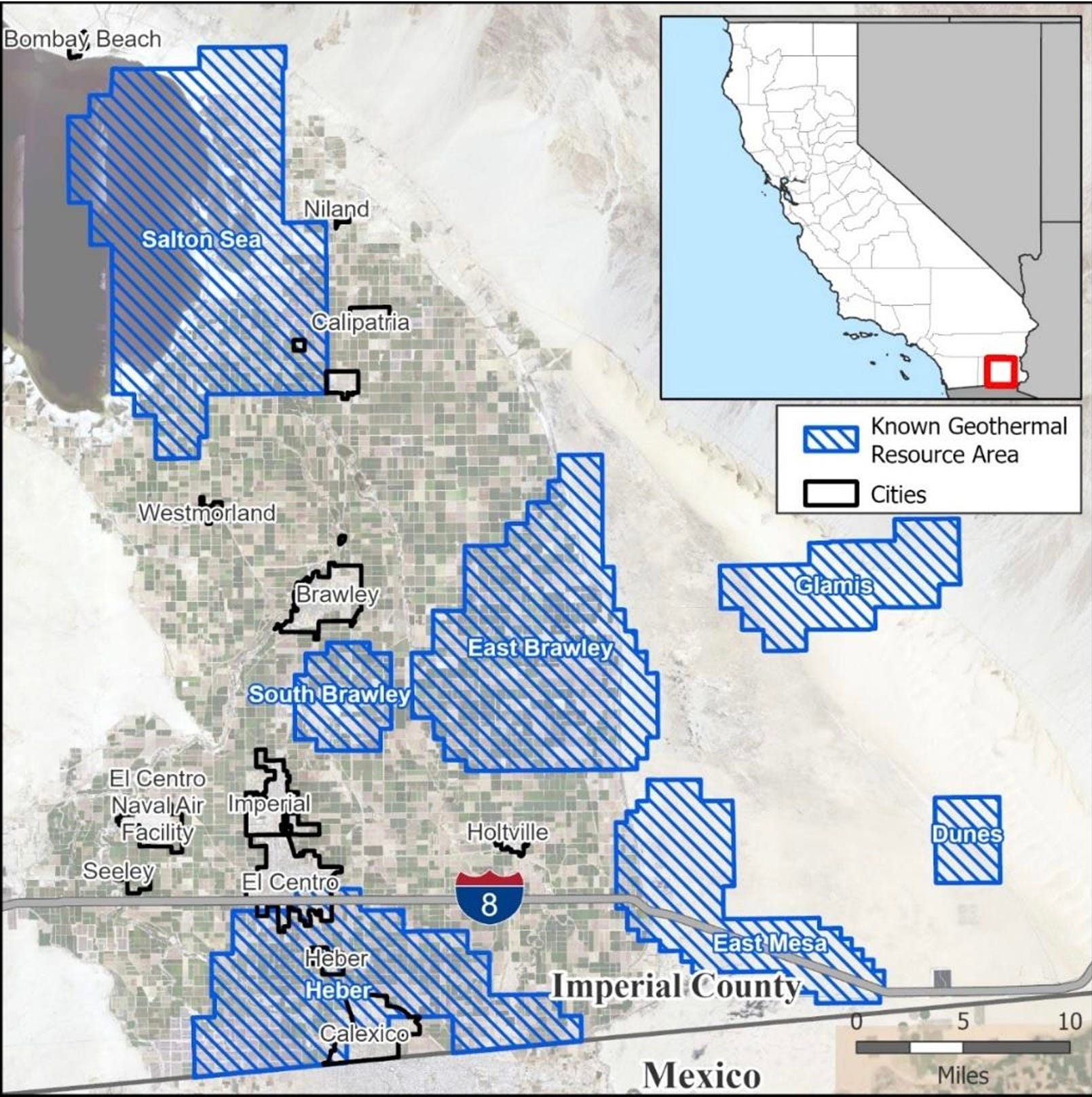
A promising development in this landscape is the Salton Sea area, where three proposed lithium projects are set to utilize direct lithium extraction (DLE) technologies, co-located at geothermal power plants. Developers BHE Renewables, EnergySource Minerals, and Controlled Thermal Resources (CTR) are actively working on projects to extract lithium from geothermal brine at existing or new geothermal power plants in Imperial County. According to data from the California Energy Commission (CEC), there are currently 11 geothermal power plants in the Salton Sea Known Geothermal Resource Area (SS-KGRA), with a combined installed capacity of approximately 414 megawatts (MW).
Estimates are that the geothermal resources in the SS-KGRA could support the development of between 2,330 and 2,950 MW of additional geothermal power plants, which is six times the current installed capacity. This expansion holds the potential to significantly bolster the region's capability to produce sustainable energy and supply crucial materials for the battery industry, thus contributing to global efforts toward energy transition and environmental stewardship.
History of the Salton Sea:
The Salton Sea, located in southeastern California, is a large, shallow, saline lake situated in the Salton Basin. It was formed in 1905 when the Colorado River breached an irrigation canal and flooded the previously dry Salton Sink. The resulting inflow formed what is now the largest lake in California, with a surface area that has fluctuated over time due to evaporation and changes in water management.
In the mid-20th century, the Salton Sea briefly became a popular resort area, known for its recreational opportunities such as boating, fishing, and birdwatching. It supported a vibrant ecosystem with a variety of fish and bird species, making it a significant stopover for migratory birds on the Pacific Flyway. However, by the 1970s, environmental issues began to plague the lake. Agricultural runoff from surrounding farms introduced high levels of nutrients and pesticides, leading to algal blooms and declining water quality. Fish die-offs became common, contributing to a decline in the lake's appeal as a recreational destination.
Today, the Salton Sea faces numerous environmental challenges. The lake's water level has been steadily declining due to reduced inflows and increasing evaporation rates, exacerbated by water diversions and agricultural practices. As the lake shrinks, the exposed lake bed contributes to dust storms, which pose serious health risks to nearby communities. The lake's high salinity levels further complicate efforts to restore its ecosystem, as many fish and bird species struggle to survive in its increasingly saline waters.
Efforts to address the Salton Sea's problems have included various restoration plans and projects. The 10-Year Salton Sea Management Program, initiated in 2017, aims to protect public health and the environment while supporting local economies. Projects under this program include habitat restoration, dust suppression, and water management initiatives. However, the success of these efforts has been limited due to the complexity of the lake's environmental and the Imperial Valley economic issues.
Hydrology of the Salton Sea Area:
Surface water is conveyed from the Colorado River to the Imperial Valley by the IID through thousands of miles of canals. Irrigation typically consumes over 95% of IID's Colorado River supplies to the region; in 2023, over 97% of IID water was used for agriculture, whereas 1.5% was for municipal potable (drinking water) uses and nearly 1% was used for commercial and industrial purposes, including geothermal production.
