In a lawsuit filed in September 2024, American Battery Technology Company ABAT 0.00%↑ took Tysadco Partners LLC to federal court over a contract breach. Tysadco picked up over 840,000 shares of ABAT stock across two March 2024 purchase agreements, but failed to wire the roughly $1.44 million it owed for them.
Instead of remitting payment, Tysadco filed counterclaims in an effort to shift its losses back onto ABAT. Tysadco alleged that ABAT and its CFO, Jesse Deutsch, fraudulently coerced them into executing those agreements by pointing to an October 2023 text message where Deutsch remarked he would “cover the losses later” on prior trades.
Beyond claiming ABAT reneged on an oral promise to “make Tysadco whole,” Tysadco leveled counterclaims of fraud, negligent misrepresentation, and Nevada state securities violations, arguing ABAT used their capital to quietly satisfy obligations to third party funds like High Trail Capital and H.C. Wainwright.
In late 2023, ABAT issued senior secured convertible notes to High Trail Capital to access up to $51 million in debt financing, receiving $37 million across two initial tranches. These notes carried toxic liquidity thresholds and debt covenants that created ongoing pressures for day to day operations. Tysadco seized on this dynamic, alleging that Jesse Deutsch made informal, unwritten promises to secure Tysadco’s capital quickly to avoid a covenant default.
However, ABAT systematically eliminated that debt position over the following years. After paying down $31.5 million in cash toward the principal, the company extinguished the remaining $8 million of the High Trail 2024 Notes through equity conversions in mid 2025, issuing roughly 9.5 million common shares across July and August.
By converting those final notes, ABAT released restricted cash reserves, removed High Trail’s restrictive covenants, and completely cleared the debt from its balance sheet. This successful payoff neutralized Tysadco’s argument that ABAT was facing an unmanageable debt crisis or engaging in a fraudulent scheme to keep the lights on.
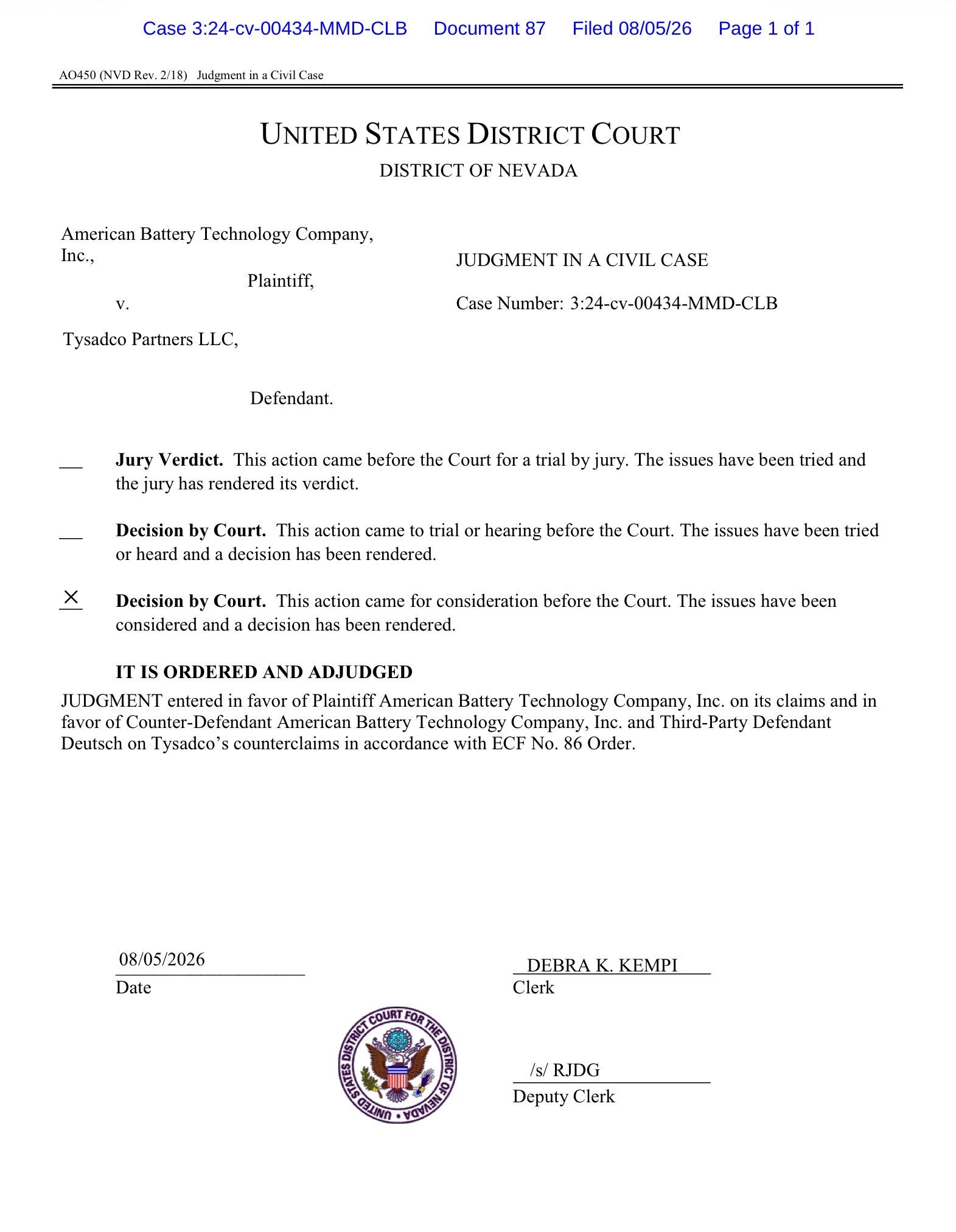
On August 5, 2026, Chief U.S. District Judge Miranda M. Du ruled in favor of ABAT in its original lawsuit, ordering Tysadco to pay $1,436,392.80 for breaching its stock purchase agreements and dismissing Tysadco’s counterclaims of fraud and misrepresentation.
Under Nevada law, unwritten side communications and informal text exchanges cannot modify fully integrated, written contracts that explicitly place market risk on the buyer. ABAT exposed the core contradiction in Tysadco’s stance by showing how Tysadco portrayed its owner as a savvy, decades-experienced trader while simultaneously claiming he was bamboozled into taking on unwritten downside risks.
Furthermore, by eliminating those debts, ABAT demonstrated to the court that its liabilities were far from unmanageable, leaving the company with no share-related debt beyond standard warrants and employee share-based incentives.
This closes out the primary growing pains era that the company experienced as it transitioned away from being an OTC listed speculative play. Early on, the only available financing came through toxic notes, a practice common with OTC stocks, alongside reliance on relationships with entities like Tysadco that ultimately resulted in massive dilution for retail investors.
Now, the company has been added to the Russell Indexes and several ETFs, sitting at around 46% institutional ownership according to Fintel, demonstrating its maturity in acquiring capital through the equity market.
I want to give a shout-out to the Tinfoil Hat and Mayonnaise Society (I know a silly name but long term investors will get the inside joke), who over the last 4-5 years have worked to help keep retail investors of ABAT informed. This is an example of the news they make me aware of.
If you found this article valuable, consider becoming a subscriber. The Critical Materials Bulletin is supported by readers, and for $5 a month or $55 a year you can help fund research that produces clear, no nonsense reporting that informs and advances the discussion on critical materials and battery metals.
Or you can buy
DISCLAIMER: This article should not be construed as an offering of investment advice, nor should any statements (by the author or by other persons and/or entities that the author has included) in this article be taken as investment advice or recommendations of any investment strategy. The information in this article is for educational purposes only. The author did not receive compensation, from any of the companies and or persons mentioned to be included in the article.