

One of the major hurdles that American lithium-ion recyclers face is archaic federal regulations. While states have the ability to lay out their own rules when it comes to hazardous waste storage and handling, which a lithium-ion recycler’s feedstock is classified as, they have to be as strict as the federal ones. This state-by-state interpretation is one of the challenges that lithium-ion recyclers face, and is something that is being addressed by a piece of legislation.

One of them is that a lithium-ion recycler cannot store its feedstock, the end-of-life and production scrap, at the same location that they process it. Unless, however, the company also has a permit from the EPA as laid out in the Resource Conservation and Recovery Act (RCRA), a federal law governing hazardous waste.
That permit is referred to as a RCRA Part B permit and would allow them to run a location as a Treatment, Storage, and Disposal Facility (TSDF). Such a permit exempts the recycling equipment and allows them to store the feedstock free of most time constraints.
But what one company, American Battery Technology Company, ABAT 0.00%↑ had been doing is using what is called a just-in-time schedule where in Nevada from the time they receive the material to the time the material is processed has to be 24 hours or less.
The EPA classifies lithium-ion cells that are being transported for the purpose of recycling as hazardous solid waste because they exhibit specific characteristics such as they are ignitable or they are reactive. Now, there is an alternate set of rules known as universal waste management, which is meant to promote recycling by lowering the operational and storage burdens for what are classified as large quantity handlers of universal waste (LQHUW).
These LQHUW can collect, sort, store, and can even remove the electrolyte if the cell is closed back up, without falling under the normal hazardous solid waste regulations. But that all stops the moment the feedstock hits the receiving bay at the recycling facility.
This is why state and federal authorities require lithium-ion recyclers to obtain a TSDF permit, though whether the state environmental agency or the EPA issues that permit depends on state authorization, as some states defer to the EPA or share jurisdiction under RCRA.
However, while federal regulations do not specify an exact time allowed to hold the feedstock prior to processing once it is accepted at the facility, a regional EPA office or a state agency through their interpretation of federal codes may establish a site-specific allowable holding time for storage of that feedstock before it has to be processed.
That is the just-in-time setup.
Back to the topic of ABAT and why I used the phrasing “had been doing” because that looks to have changed when ABAT purchased another location in March 2026, which makes them the owners of four locations in Nevada that falls under the company’s recycling vertical umbrella.
There is, of course, the main location referred to as the TRIC facility, along with an empty lot on Sydney Drive by one of the security gates for Tesla’s Nevada Gigafactory, the property in Fernley that was under construction as the original site for the company’s recycling operations before they purchased the TRIC location. Now the company has this new property and it is located right next door to the TRIC facility.
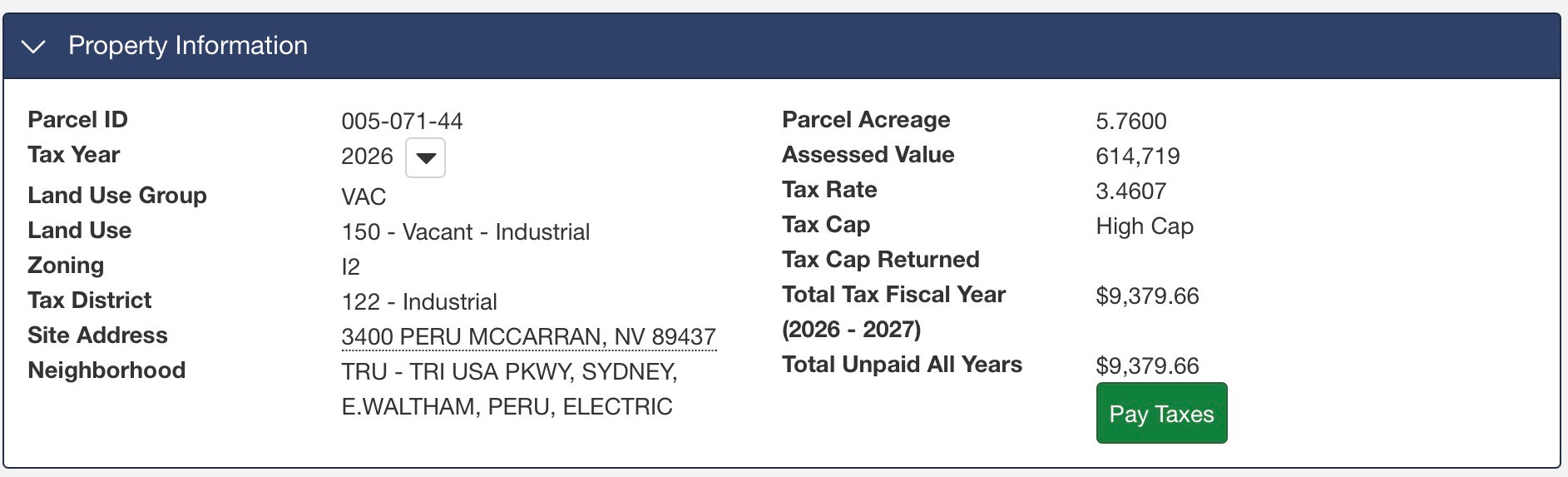
A screenshot from google maps.
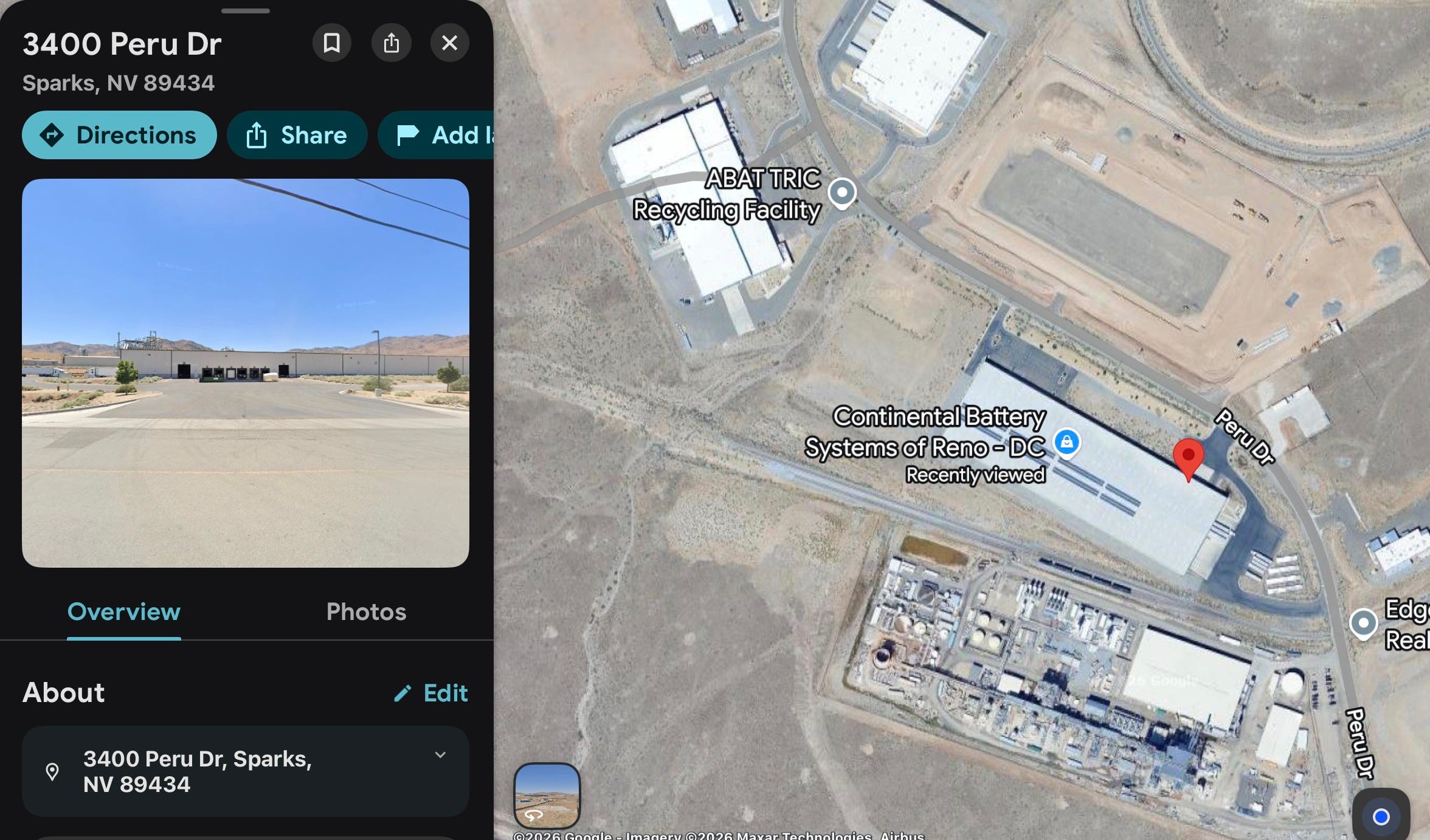
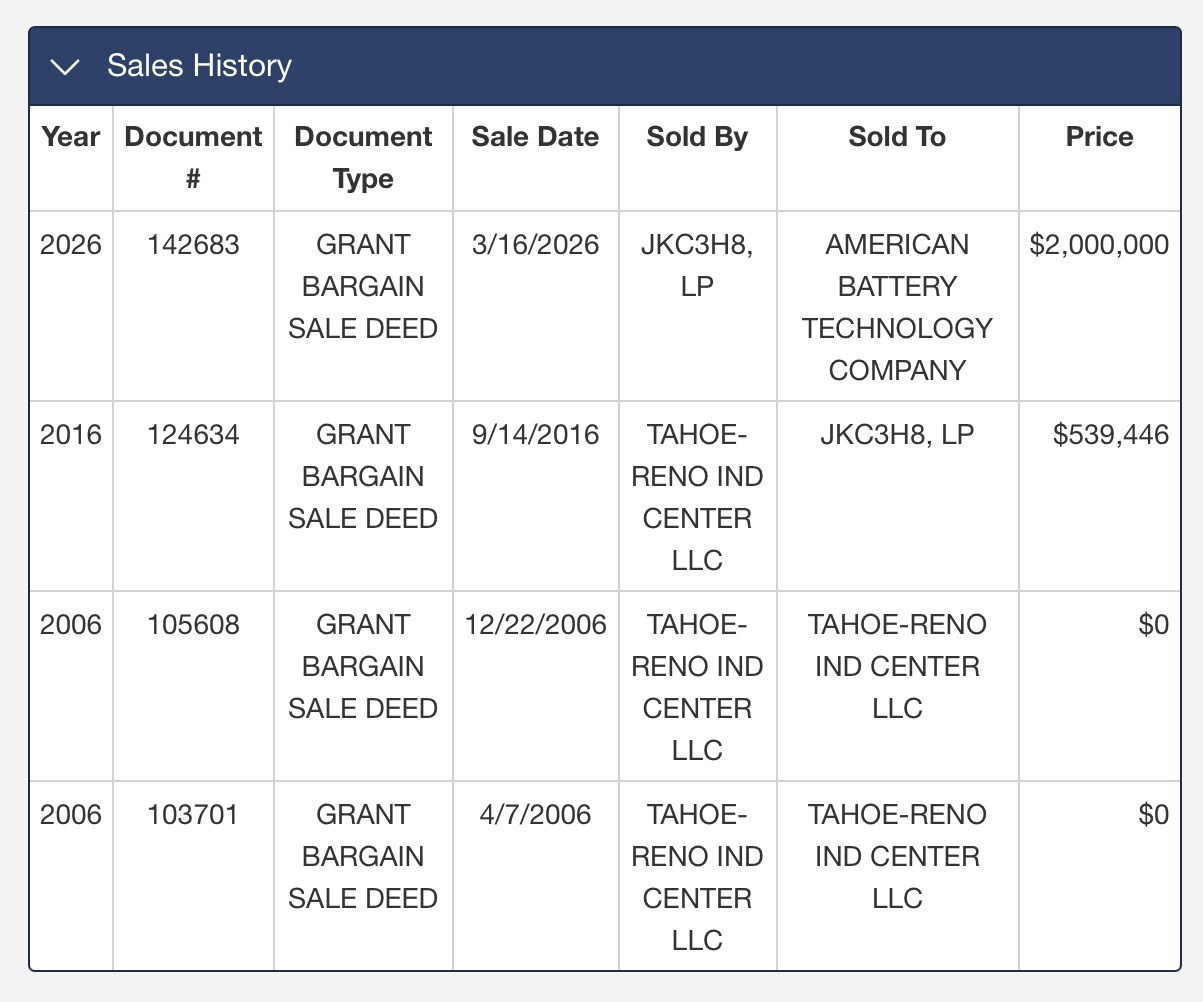
They bought this location for $2 million and it that looks to be part of a larger complex that also has a battery wholesaler.
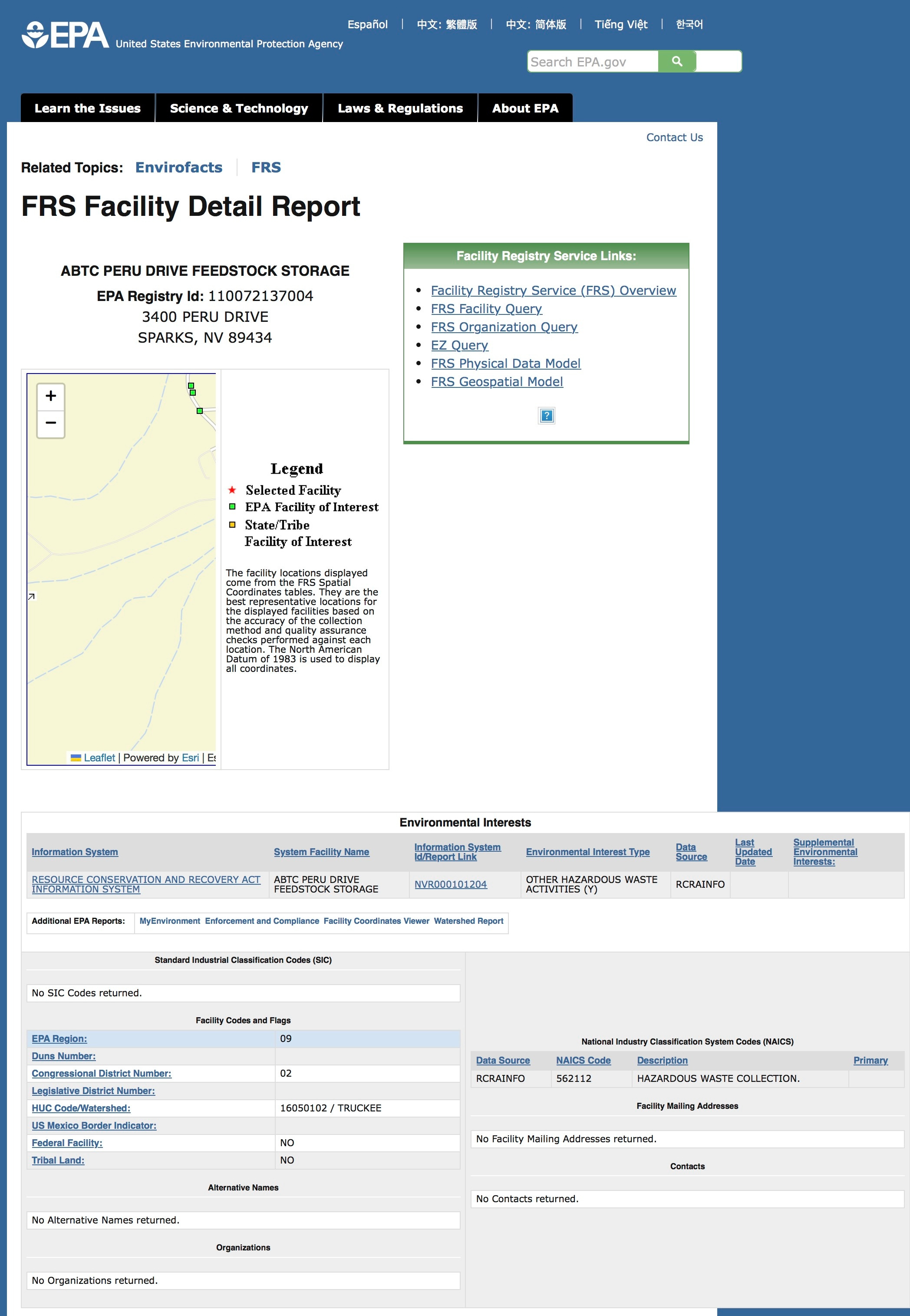
This location has the EPA designation as “ABTC Peru Drive Feedstock Storage” with the EPA Registry ID: 110072137004. The North American Industry Classification System (NAICS) is the code used by federal agencies to classify business establishments by type of economic activity, and for this location it is 562112 Hazardous Waste Collection.
This would allow them to move away from the just-in-time schedule for at least what is considered non-damaged, defective, or recalled material, which the modules from the Moss Landing site would be classified as, so for regular feedstock this location could in theory give them some breathing room.
Since the NAICS code is 562112. These are the activities that would be conducted at that location:
Hazardous waste collection services
Radioactive waste collecting and/or local hauling
Hazardous waste hauling (local)
Operation of hazardous waste transfer stations
Collection and transportation of industrial hazardous waste
Medical and healthcare hazardous waste collection services
This location does not have a RCRA Part B permit used for TSDF, which would use NAICS code 562211 Hazardous Waste Treatment and Disposal. Instead, since it has NAICS code 562112, Hazardous Waste Collection, it falls under different usage rules, ones that only allow temporary storage.
Under approved activities like hazardous waste collection services and collection and transportation of industrial hazardous waste, the facility at 3400 Peru Dr. operates under 40 CFR 263.12(a). This RCRA provision codified into federal law allows a transporter to store hazardous waste in containers at a designated transfer facility for 10 days or less without triggering full TSDF permitting and other related regulatory provisions outlined under RCRA.
If material remains on site for more than 10 days, the location becomes subject to full TSDF requirements unless an accumulation time limit extension is granted by the EPA or the state.
Ten days is better than 24 hours, and this also gives them the ability to better coordinate with OEMs to make sure that they can receive their material in a more timely manner.
This would also indicate that at current operating throughput, a $2 million expenditure was worth adding 10 days of storage to the Nevada recycling vertical. This may have been a direct result of the volume of material from Moss Landing, or it might be that they were unable to fully meet their clients’ needs with a just-in-time schedule due to capacity constraints, and that storage allows more flexibility for their clients and for the company to better meet their recycling needs.
One of my concerns was that due to capacity constraints, ABAT might struggle to expand and grow their clientele, but adding this storage could be part of the solution. As I have said before, as problems go, having more feedstock than you can process is not a bad one to have.
If you found this article valuable, consider becoming a subscriber. The Critical Materials Bulletin is supported by readers, and for $5 a month or $55 a year you can help fund research that produces clear, no nonsense reporting that informs and advances the discussion on critical materials and battery metals.
Or you can buy
DISCLAIMER: This article should not be construed as an offering of investment advice, nor should any statements (by the author or by other persons and/or entities that the author has included) in this article be taken as investment advice or recommendations of any investment strategy. The information in this article is for educational purposes only. The author did not receive compensation, from any of the companies and or persons mentioned to be included in the article.